Why SAP “Modernisation” No Longer Means Anything - SAP's Singularity Problem
How SAP Modernisation Lost Its Meaning
This newsletter is written in the style of a person truly hacked off with the SAP consulting ecosystem, time and time again I see the term modernisation used as the mis-placed rationale to rip out SAP ECC, Legacy S/4 or BW....
“Modernisation” has become one of the most abused words in the SAP ecosystem.
It is routinely wheeled out as a pseudo-derogatory label for SAP ECC customers that show no sign of moving to S/4 Private Cloud, serving as a convenient prelude to the supposedly inevitable conclusion that the only rational, responsible, future-proof option is a full rip-and-replace to S/4HANA. Fail to “modernise”, and the implication is blunt: you’re a laggard. The cool kids have moved on — and you’re not one of them.
That narrative isn’t just lazy. It’s wrong.
So let’s start with the obvious question that almost never gets asked:
What does modernisation actually mean in the context of SAP customers?
Because “being digital” isn’t modern.
Digital operating models are firmly Industry 3.0. They’ve been commoditised for five decades. SAP R/1 was arguably the first true enterprise digital platform, and ECC has been enabling global, integrated digital businesses.
What has changed is the pace of change.
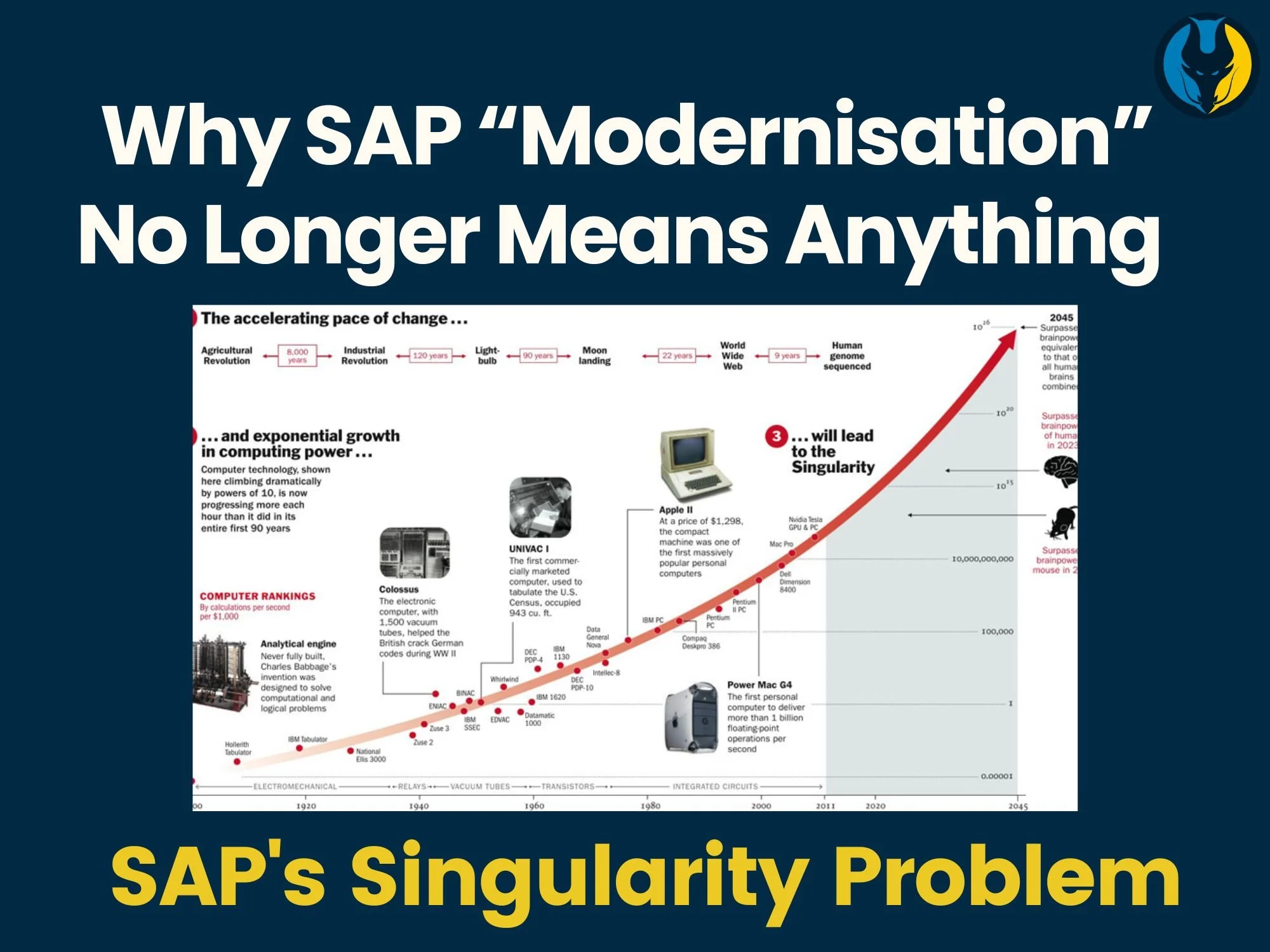
We’re now in an era of accelerating technological singularity. Robotics, Quantum, AI-driven capability expansion, agentic systems, automation, simulation, and decision intelligence are compressing innovation cycles to the point where something considered “modern” in 2025 risks being labelled “legacy” by 2026.
Against that backdrop, the way “modernisation” has been used in SAP is borderline absurd.
Instead of describing ongoing enterprise Kaizen, continuous improvement across architecture, operating model, process, and business design, modernisation was repurposed as a marketing smoke screen. A justification for tearing out a functioning enterprise core that provides a stable process and sematic data foundation and starting again.
That isn’t modernisation.
That isn’t Kaizen.
That’s technology vandalism.
And worse, it often blocks genuine improvement. Multi-year transformation programmes freeze change, defer value, consume organisational oxygen, and leave businesses less adaptable than when they started. The promised benefits of “the cloud” rarely materialise beyond being an enabler, not an outcome. Cost, agility, and innovation gains are usually marginal at best.
A major Lesson to be Learnt, which is wholly applicable in the Age of AI
Why did SAP and the consulting industry mis-use the term modernisation ? well in my humble opinion, SAP screwed up by breaking the fundamental rules of how SAP maintenance is budgeted and SAP TCO is calculated. All SAP customers pre S/4 used to work on the basis that there would be some form of major upgrade to the SAP platform over a 4 to 5 year term.
Because of tech singularity, you can't guess why you will need to upgrade but you know you will ! and you also know that +/- it will be 80% techy and 20% functional requiring a functional project team to carry out the full delivery lifecycle including business change.
Then SAP broke this model... by making the move from ECC to S/4 a total car crash, instead of the normal upgrade path, SAP were instead asking the customer to make huge rip it out and start again changes with little benefit ! with a cost and disruption impact many SAP customers are not prepared to tolerate.
If the migration path had been simpler the bulk of the SAP ECC customer base would be on S/4 and most on PCE, investing heavily in the Suite and AI.
Just let that sink in
So CIO's where ever you are now with your SAP ERP, what ever flavour, budget NOW for a major platform change in the next 4 to 5 years, this should be added to the SAP AMS budget with the upgrade element accrued to the upgrade cost centre. Why, no idea but I'd bet my West Ham United FC season ticket you will need it.
Modernisation, in its true sense, should increase an organisation’s ability to change, not suspend it.
Today’s reality is that SAP’s own evolution (see below), combined with the rise of AI and the economic pressure to lock in legacy ECC and BW customers
SAPs YE Results – Time for the 5X Pivot — Dragon ERP
https://www.linkedin.com/pulse/rocket-man-shooting-stars-sap-5x-wake-up-call-alisdair-bach-6y7re
demands a very different model. One that accepts:
Architecture is never “done”
Operating models must evolve incrementally
Value is delivered through focused, short-shaped change
Not every improvement requires a platform rewrite
This is where the idea of an SAP Omniverse starts to matter, an upcycled modular, composable enterprise core (ECC + S/4) enabling a stable process and data foundation (no one cares about clean core, customisation is not tech debt) surrounded by AI, automation, and specialised plug and play micro-services capability that can evolve independently. A model built for acceleration, not reinvention cycles.
In that world, terms like modernisation and its equally misguided cousin clean core become actively unhelpful. They imply an end state. A destination. A moment where you can declare victory and move on.
Singularity doesn’t work like that.
If change is constant, then modernisation as a one-off event is a contradiction. What’s required instead is continuous Kaizen at enterprise scale, sometimes maintenance, sometimes op-model optimisation, sometimes genuine business model change, but always anchored in tangible benefit.
What is Singularity
Technological singularity is the point where technology, can learn, decide, act, sense, remember and optimise faster than humans can directly manage. In practice, it means decision-making becomes continuous rather than periodic, and by 2030 ERP will be cognitive. SAP Joule will have morphed and will be the MES built into hive robots, this isn't science fiction it's already been announced.
Industry 4.0 is how this idea shows up in the enterprise. It is about refining the (Kaizen) the legacy Industry 2.5 (Credit Paul Byrne) 3.0 operating models, it will sense what is happening, decide what to do, execute actions, and learn from outcomes in near real time. The goal is not full autonomy, it is adaptability at scale.
SAP (as a composable platform) sits at the centre of this as the operating model core providing a stable process and semantic data foundation. It holds financial truth past present and future, extended process state, and compliance rules, providing the guardrails that prevent intelligent systems from creating uncontrolled risk. SAP will provide the intelligence, with control.
Because technology evolves faster than traditional business transformations, the target operating model should not be ripped out to start again, because the pace of change means that what ever is delivered is already legacy ! Instead a composable, plug-and-play SAP landscape allows capabilities and AI services to be added through Kaizen, replaced, or retired without destabilising the intelligent process and data core.
AI (Joule, Walkme and Signavio) then wraps around these processes, observing, predicting, recommending, and executing within defined limits. Humans set intent and policy, AI handles speed and complexity, and SAP enforces governance.
In that sense, the singularity is not a future moment. It is already arriving quietly inside enterprise systems, and the organisations that succeed will be the ones that design for it rather than resist it.
The path to enterprise survival not modernisation = Enterprise Kaizen
Enterprise kaizen works across all levels of the organisation, from individual process optimisation, through lines of business and organisational sub-units, up to the enterprise as a whole. Improvements at each level are connected rather than isolated, so local optimisation feeds enterprise outcomes rather than competing with them. This is enabled through a bi-modal portfolio delivery model, where stable core operations are continuously improved while adaptive initiatives experiment, learn, and scale. Agentic governance provides the glue, coordinating priorities, enforcing constraints, and allowing intelligent systems to optimise within agreed boundaries. The result is a continuously improving enterprise where change is incremental, aligned, and sustained, rather than episodic and disruptive.
CFO's and CIO's My Legacy SAP ECC prediction - An Example of the SAP Omniverse, Enterprise Kaizen and AI
Whilst there are still some mega deals, SAPs long term growth strategy is to drive Suite and AI revenue (including customer specific bespoke agentic AI) from its legacy customer base, and it will need to start monetarising from Q2 onwards. SAPs customers will not want rip it out and start again, and they will not want to gamble their innovation budget on large scale AI, they want to experiment, link this together and you have the makings of Enterprise Kaizen.
But many SAP customers are legacy ECC and Legacy S/4 (early S/4 adopters needing to upgrade and possible move to SAP Cloud hosting) and are not any where near close to having the right SAP S/4HANA PCE 2025 and SAP BTP architecture to support SAP's current AI model.
Further more for SAP to be able to offer customer specific bespoke Agentic they will need to drop Joule on to the legacy architecture.
So my prediction is that SAP will need to drop into the market
Some form of enhance pack AI bridge enabling the deployment of Joule, same goes for WalkMe. At the same time expect to see AI agents dropping in and around legacy ERP and BW. Wrap around is the only short term path.
This will come with some form of prid pro quo with the move of the legacy ECC and BW estate to PCE, setting the client up for a composable agentic move to future ERP long before any 2033 deadline.
The above has it all, the adoption of tech singularity pace enabled by kaizen giving SAP the growth they need from the legacy customer base.
So yes, I’m hacked off with Modernisation
Hacked off with lazy language. Hacked off with false binaries. Hacked off with the usual suspects selling reinvention as progress.
Because in a world shaped by accelerating change, the most “modern” thing an enterprise can do isn’t to rip out its core, whilst SAP need to embrace the Kaizen concept and make it front and centre of every conversation as this is the only path to drive revenue growth.
Need help shaping where next
That's where I come in, message me or buy me a coffee its that simple and lets have a chat
Alisdair
About the Author
Alisdair Bach is a recognised SAP Programme Director and turnaround specialist — often called a “turnaround king” by clients for his ability to stabilise and recover the most complex and failing SAP programmes. With decades of experience across global private equity and public sector portfolios, Alisdair has led high-stakes SAP S/4HANA transformations, finance and supply chain turnarounds, and complex delivery rescues.
Alisdair is also a SAP analyst working to define for investors where next with SAP, he is a author and lecturer, he defined the SAP upcycling concept as the alternate narrative to rip it out and start again clean core that is counter intuitive to AI adoption and SAPs 5X growth strategy.
Through Dragon ERP, he brings board-level assurance, forensic diagnostics, and hands-on leadership to programmes that others have written off — combining empathy with no-nonsense execution to deliver results where failure once seemed inevitable.

