Guns, AI and SAP, The Defence Revenue Pivot
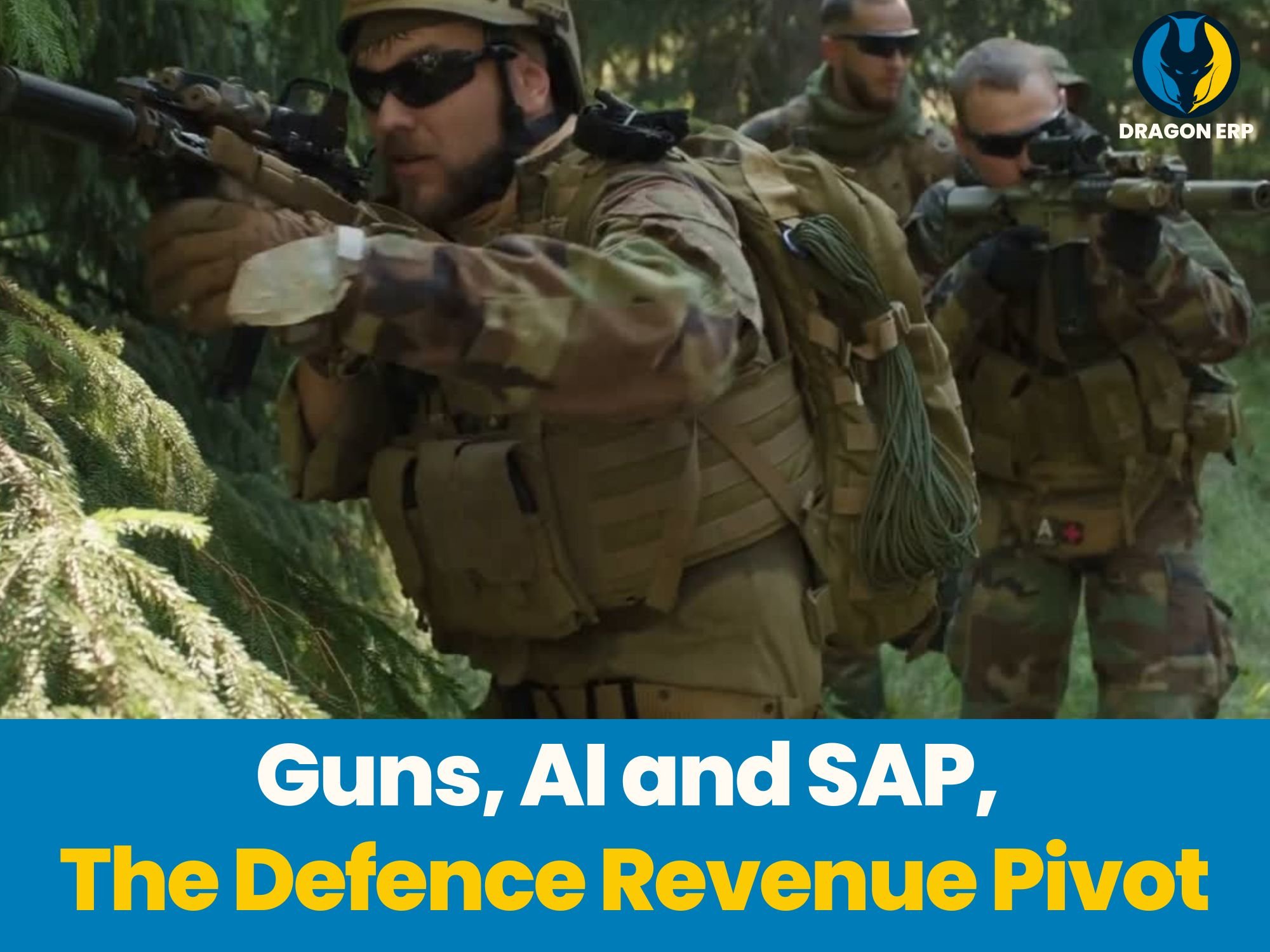
Europe is rearming, and this time it is visible in the numbers.
EU defence expenditure reached €343bn in 2024 and is expected to rise to €381bn in 2025, with many member states now spending above 2 percent of GDP. Alongside that shift, the EU’s Readiness 2030 agenda points to hundreds of billions in additional defence investment over the coming years.
This is more than another funding cycle. It signals a structural change in how Europe approaches sovereignty, resilience and military capability.
Within that context, SAP’s launch of its Defence Innovation Hub in Munich looks deliberate. It is positioning itself inside a long-term European priority rather than reacting to a passing trend.
Defence Has an Enterprise Weakness
Defence conversations often centre on aircraft, cyber capability and AI-enabled command systems. Yet operational effectiveness depends on something less visible.
Readiness is shaped by maintenance cycles, supply chains, procurement controls, workforce planning and financial governance. If spare parts are not where they should be, if maintenance data is unreliable, or if skills and clearances are not aligned with deployment needs, capability on paper does not translate into capability in theatre.
Many defence organisations still operate across fragmented ERP landscapes and siloed data structures. Logistics remains partially manual, reporting is inconsistent, and visibility across the full value chain can be limited.
Advanced AI platforms cannot compensate for weak enterprise data. If the underlying systems are unstable, everything built on top of them is exposed.
This is the space SAP is targeting.
SAP is about to become the NATO standard as a Defence Operating Model for Europe and NATO, that's massive.
A Defence-Specific Digital Core
SAP is not simply adapting generic ERP. It has developed a dedicated industry solution, SAP S/4HANA Defence & Security, built directly into the S/4HANA core.
The solution supports force structure modelling aligned to military organisations, mission-based planning, real-time logistics visibility, maintenance and readiness workflows, integrated procurement and finance controls, and workforce management suited to defence structures.
Beyond the core platform, SAP’s broader Defence and Security industry portfolio spans the full operational value chain. Mission planning, logistics, procurement, maintenance, finance and workforce support sit on an integrated digital foundation with security and compliance embedded throughout.
The Defense Innovation Hub in Munich acts as a working environment where these capabilities can be tested, demonstrated and refined alongside defence institutions and ecosystem partners. It is intended to translate platform capability into operational context.
Secure Cloud Experience
SAP also brings experience from operating in secure national security environments.
Through SAP NS2 in the United States, SAP supports defence and national security agencies in cloud environments aligned with DISA and FedRAMP authorisations. These environments support mission-critical planning, emergency response and coordinated operations under strict security controls.
Europe’s sovereign cloud model will evolve differently, but the principle remains consistent. Defence customers expect hardened infrastructure, controlled access models and compliance frameworks designed in from the outset. SAP can demonstrate that it has operated in such environments before.
Where Palantir Fits
Modern defence architecture is layered, and Palantir Technologies occupies a different position in that stack.
Through platforms such as Palantir Gotham, the Maven Smart System and Palantir AIP for Defence, Palantir operates at the mission intelligence and decision-support layer. Its strength lies in fusing disparate intelligence sources, building real-time operational pictures and enabling AI-assisted command decisions within classified environments.
SAP operates further down the stack, at the enterprise readiness layer.
Maintenance records, equipment master data, inventory levels, contractual commitments and personnel readiness are typically held in enterprise systems. Platforms like Palantir can ingest and analyse that data to enhance operational awareness.
Without trusted enterprise data, advanced analytics lose credibility. Without advanced analytics, enterprise systems can struggle to respond at operational tempo. Together, they create a more resilient digital architecture.
This is less a question of competition and more a question of alignment across layers.
What I have no visibility over yet is how SAP Business Data Cloud fits into the Defence model, but I'm sure it does.
Why the Pivot Makes Commercial Sense - A 5X Boom
There is also a clear revenue logic behind this move.
Large S/4HANA transformation programmes will taper as we reach the end of modernisation excluding defence. AI-driven revenue embedded across the installed base will grow, but likely at a steady pace as customers adopt progressively and SAP refine their Joule, AI and S/4 products to enable ECC revenue recognition (yes ECC not S/4)
European sovereign cloud initiatives and defence transformation programmes represent a substantial, politically supported investment cycle. Defence modernisation is typically long-term and ecosystem driven. When defence organisations standardise on a digital backbone, primes, subcontractors and logistics providers often align their systems accordingly.
If European defence increasingly adopts SAP at scale, parts of the broader military supply and industrial chain are likely to follow or integrate deeply with SAP tooling.
This shift should interest existing commercial customers and partners. Investments in secure infrastructure, resilience by design and sovereign operating models tend to raise standards across other regulated sectors as well.
Over the past year, SAP has also moved closer to the European policy conversation, positioning its technology as a contributor to competitiveness and productivity. Yet Europe’s most pressing structural issue today is not only economic.
With Russia acting as a destabilising force and the United States signalling that Europe must assume greater responsibility for its own security, defence has become a central strategic concern.
SAP has recognised that shift and aligned itself accordingly, well done Christian Klein, you have seized the day and shown outstanding leadership.
The Broader Picture
Europe’s defence posture will depend not only on hardware but on coordination, supply chain resilience, digital sovereignty and transparency across allied ecosystems.
Countries that can govern readiness with clarity and confidence will have an advantage over those that cannot.
SAP is betting that enterprise digital resilience becomes as strategically important as operational intelligence. Given the trajectory of European defence spending and political priorities, that appears to be a carefully judged move rather than a speculative one.
Why Work With Me and Dragon ERP
The defence pivot raises a practical question for many organisations.
If SAP is becoming more central to European defence readiness, how do programmes avoid repeating the mistakes of past large-scale transformations?
Because defence ERP programmes are rarely simple technology projects. They are multi-stakeholder, politically visible, operationally sensitive and deeply intertwined with procurement, supply chains and workforce reform. When they struggle, the impact is not just financial, it is strategic.
That is where Dragon ERP operates.
Dragon ERP focuses on stabilising, reshaping and assuring complex SAP programmes, particularly where delivery risk, governance gaps or architectural fragmentation threaten outcomes. The approach is pragmatic, non-theatrical and grounded in experience of large S/4HANA and enterprise transformations.
In the defence context, that means:
Ensuring S/4HANA Defence & Security is implemented as a readiness platform, not just a finance replacement
Aligning enterprise architecture with sovereign cloud and security constraints
Creating role design, access control and identity models that work across secure environments
Stabilising supply chain and logistics processes before layering advanced analytics on top
Providing independent assurance where public scrutiny and political visibility are high
As SAP expands its defence footprint, the risk is not lack of ambition. The risk is complexity.
Defence modernisation programmes will involve ministries, agencies, industrial partners, system integrators and technology vendors, often across borders. Without disciplined architecture, governance and programme leadership, fragmentation can quickly reappear inside a supposedly integrated platform.
That is precisely the type of environment Dragon ERP was built for.
The defence pivot is not just an SAP story. It is a programme execution story. And the difference between a resilient digital backbone and another stalled transformation will come down to how well it is shaped, governed and delivered.
If your organisation is exploring SAP in defence, sovereign cloud or large-scale S/4 modernisation in regulated environments, that is a conversation worth having.
About the Author
Alisdair Bach is a recognised SAP Programme Director and turnaround specialist — often called a “turnaround king” by clients for his ability to stabilise and recover the most complex and failing SAP programmes. With decades of experience across global private equity and public sector portfolios, Alisdair has led high-stakes SAP S/4HANA transformations, finance and supply chain turnarounds, and complex delivery rescues.
Alisdair is also a SAP analyst working to define for investors where next with SAP, he is a author and lecturer, he defined the SAP upcycling concept as the alternate narrative to rip it out and start again clean core that is counter intuitive to AI adoption and SAPs 5X growth strategy.
Through Dragon ERP, he brings board-level assurance, forensic diagnostics, and hands-on leadership to programmes that others have written off — combining empathy with no-nonsense execution to deliver results where failure once seemed inevitable.

