Closing The AI Value Gap
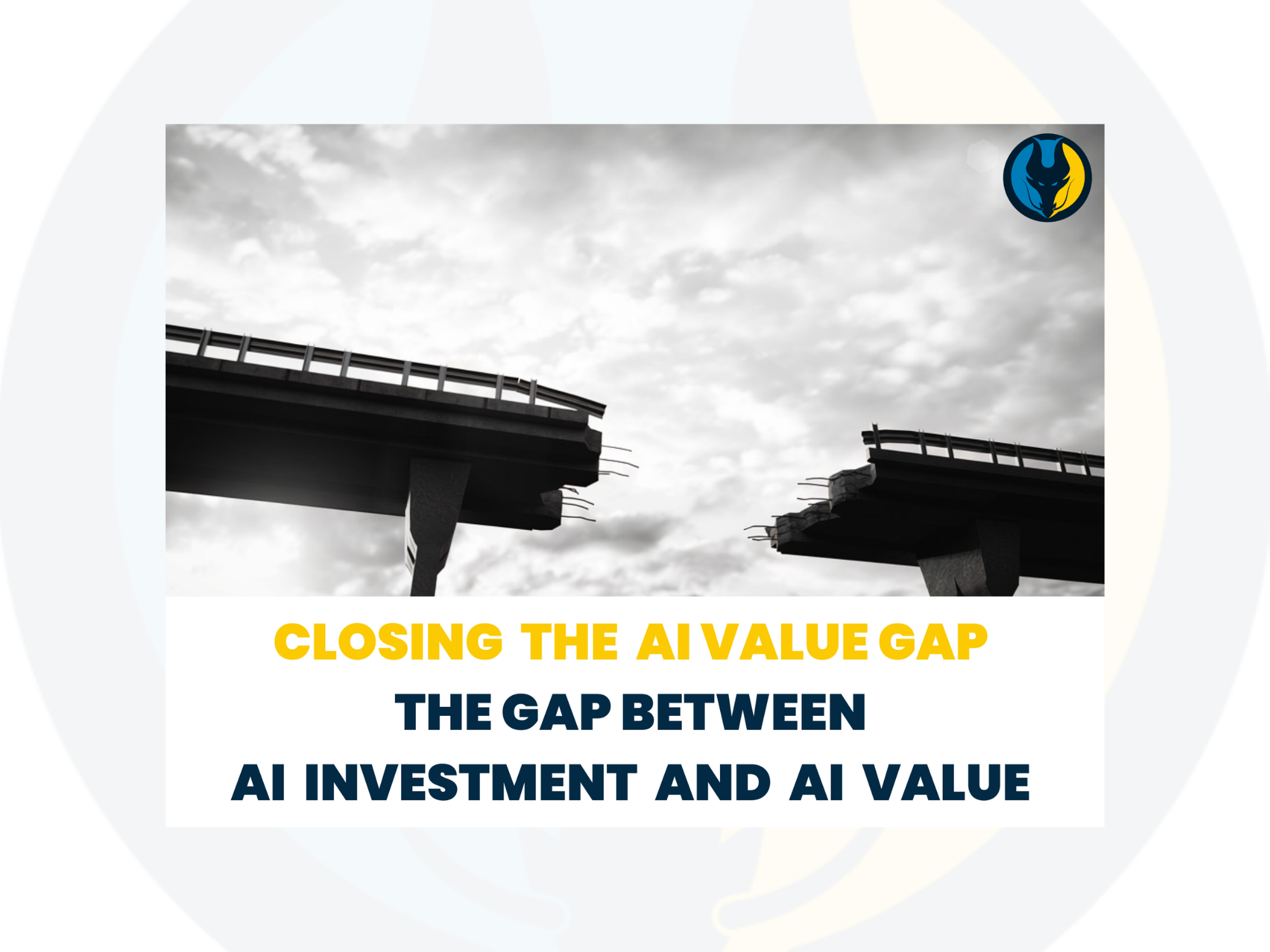
Closing the Gap Between AI Investment and Enterprise Value
What you will gain from this blog
AI investment is moving fast. The real question is whether the value is moving with it.
This blog looks at why many organisations are struggling to turn AI activity into measurable business outcomes, why System Integrators are regrouping around AI delivery hubs, and why SAP sits right at the centre of the enterprise AI value conversation.
It also explains why closing the AI Value Gap is not about chasing perfect data. It is about exposing the data, process, controls and history already sitting inside the enterprise, so AI can operate with context.
Finally, it sets out how Dragon ERP Phase Zero helps organisations take the risk out of AI adoption before they commit to large-scale spend.
The C Suite and Investor Optic
Every board has an AI strategy.
Every major software vendor has an AI roadmap.
Every System Integrator now has an AI practice, AI Centre of Excellence, or delivery hub built to accelerate adoption.
The money is moving. The market is moving. The pressure is building.
But one question keeps coming back in boardrooms.
Where is the value?
Billions are being spent on technology, consulting, infrastructure and experimentation. Yet many organisations still struggle to point to clear improvements in margin, productivity, working capital, customer experience or competitive advantage that can be directly linked to AI.
That does not mean AI has failed.
It means deploying AI and creating enterprise value are not the same thing.
At Dragon ERP, we call this the AI Value Gap.
It is the gap between spending money on AI and turning that spend into measurable business performance.
What the Data Says
Research suggesting that up to 95% of enterprise GenAI initiatives are not yet delivering measurable financial impact has caught attention because it feels uncomfortably familiar.
Most organisations are busy with AI.
But busy is not the same as valuable.
There are pilots everywhere. Co-pilots have been switched on. Chatbots have been built. Innovation teams are active. Consultants are mobilised. Licences have been bought.
Then the board asks the awkward question.
What has changed in the numbers?
Has margin improved? Has cash collection accelerated? Has procurement leakage reduced? Has forecast accuracy improved? Has order-to-cash got faster? Has operational risk reduced?
If the answer is vague, the organisation is probably sitting inside the AI Value Gap.
Market Reality: The SIs Are Regrouping
The first phase of enterprise AI was experimentation.
The second phase is industrialisation.
SAP and the wider enterprise software market are pushing hard into AI-enabled transformation. Partner funding, AI accelerators, embedded agents, Joule, Business AI and industry use cases are creating a new commercial wave.
System Integrators are responding in the way you would expect.
They are building AI Centres of Excellence, offshore and nearshore delivery hubs, reusable accelerators, agent factories and repeatable deployment models.
Commercially, it makes sense.
Customers want AI. Vendors want adoption. Partners want attach revenue. The market wants growth.
But there is a risk.
The industry may become very good at scaling AI deployment before customers become good at scaling AI value.
A delivery hub can deploy tools.
It cannot guarantee that the enterprise is ready to absorb, govern and monetise them.
CIO Perspective: AI Needs Enterprise Context
Too many AI conversations still start and end with data quality.
That is too narrow.
The issue is not whether every data field is perfect. The issue is whether AI can see enough enterprise context to understand how the business actually works.
AI needs to see the transaction, the process path, the approval, the exception, the control point, the decision trail, the financial consequence and the operational outcome.
This is why SAP matters.
SAP is not just a system of record.
It is the enterprise memory layer.
It holds the history of what was bought, sold, shipped, billed, paid, approved, rejected, reversed, delayed, escalated and corrected.
That history is what makes AI useful.
Not because the data is perfect.
Because the data has context.
The job is not simply to cleanse data before AI can start. The job is to expose data, process and history safely, so AI can reason inside the real operating model of the enterprise.
Who Owns the AI Control Plane?
As AI moves from assistants to agents, governance becomes unavoidable.
Who owns the AI Control Plane?
Who decides which agents can operate? Which systems they can access? What decisions they can recommend? What actions they can take? What financial thresholds apply? Who is accountable when AI influences a decision?
This is not theory. This is the next enterprise control problem.
Without a clear AI Control Plane, organisations risk creating intelligent shadow IT.
Different functions will deploy different tools. Different vendors will embed different agents. Different teams will apply different rules. Different data sets will create different truths.
That is not transformation.
That is fragmentation with better interfaces.
CFO Perspective: AI Is a Capital Allocation Problem
For the CFO, AI is not mainly a technology issue.
It is a value issue.
The CFO is not asking whether AI is interesting. They are asking whether it changes the economics of the business.
Does it reduce cost to serve? Improve margin? Accelerate cash? Reduce leakage? Improve forecasting? Lower risk? Create new revenue?
Licences are easy to buy. Pilots are easy to approve. Consulting teams are easy to mobilise.
Value is harder.
The CFO needs a sharper assurance model.
Not “how many AI use cases do we have?”
But:
Which AI use cases are tied to measurable financial outcomes?
Which are embedded in controlled business processes?
Which can be scaled safely?
Which should be stopped?
That is when the AI Value Gap becomes a board-level issue.
Strategic Question
The question is no longer whether organisations should invest in AI.
Most already are.
The better question is:
How do we convert AI investment into measurable enterprise value without scaling risk?
That question changes the conversation.
It moves AI away from technology adoption and into enterprise readiness.
It forces the organisation to understand where value is created, where work really happens, where process history sits, where controls exist, and where AI can make a measurable difference.
This is where Enterprise Kaizen becomes important.
Enterprise Kaizen: The Missing Middle
Most organisations are stuck between two bad choices.
At one end, endless experimentation. Lots of pilots. Lots of activity. Very little operational change.
At the other end, blind scaling. Enterprise licences. Mass rollout. Big SI programmes. Large adoption targets. Unclear value.
Neither closes the AI Value Gap.
The missing middle is Enterprise Kaizen.
Enterprise Kaizen is disciplined, continuous improvement of the enterprise process core using AI, automation, edge intelligence and operational insight.
It is the half-way house between experimentation and reckless scaling.
It asks practical questions.
Where does work slow down? Where do exceptions repeat? Where does human judgement add value? Where are controls duplicated? Where is cash trapped? Where are decisions delayed? Where does SAP already hold the history needed to improve performance?
This is how organisations create the AI leapfrog.
Not by buying more AI.
By using AI to improve the enterprise process core faster, safer and more intelligently than competitors.
AI and Edge: Why the Process Core Matters
AI value is not only created in dashboards or office workflows.
It is also created at the edge of the enterprise.
Warehouses. Factories. Stores. Field service. Logistics. Maintenance. Asset-heavy operations.
That is where process meets reality.
But edge AI only creates enterprise value when it connects back to governed process.
A sensor reading, image recognition event, robotic action, store exception or maintenance signal only matters if it triggers the right enterprise response.
That response may be a purchase order, service order, replenishment decision, production adjustment, billing correction, quality notification or working capital impact.
Very often, that response sits in SAP.
Without that connection, edge AI becomes another disconnected technology layer.
Interesting, but not transformational.
What Leading Organisations Are Doing
Leading organisations are becoming more disciplined.
They are not asking, “Where can we use AI?”
They are asking, “Where can AI improve enterprise performance?”
They are exposing business context before scaling agents.
They are defining AI ownership before autonomy expands.
They are treating SAP as enterprise memory, not just an old ERP platform.
They are measuring business outcomes, not adoption activity.
Most importantly, they are learning before they scale.
That is the Enterprise Kaizen mindset.
Dragon ERP Perspective
Dragon ERP believes the AI Value Gap is not caused by a lack of technology.
It is caused by a lack of enterprise readiness.
Organisations are being pushed to accelerate AI adoption, but many have not yet exposed the process, history, ownership and control structures needed to turn AI into value.
That is why Dragon ERP Phase Zero exists.
Phase Zero is designed to close the AI Value Gap before organisations commit to large-scale AI spend.
It is not an AI strategy document.
It is not a vendor roadmap.
It is not a generic readiness checklist.
It is an independent enterprise value assessment focused on SAP-centred AI adoption.
Phase Zero helps answer the questions that matter.
Where is the value? Where is the process history? Where can AI safely act? Where should AI only advise? Where are the control risks? Who owns the AI Control Plane? Which use cases should scale? Which should stop? What needs to happen before major investment is made?
How Phase Zero Closes the AI Value Gap
Phase Zero creates the bridge between ambition and value.
It helps organisations expose the enterprise memory already sitting inside SAP, identify where AI can improve financial or operational performance, and map where data, process and history are visible, hidden or fragmented.
It also helps define the AI Control Plane ownership model, assess which AI use cases are safe and scalable, and apply Enterprise Kaizen to create near-term improvement without destabilising the business.
This is how organisations take the risk out of AI adoption.
Not by slowing down.
By making sure acceleration is pointed in the right direction.
Executive Takeaway
The winners of the AI era will not be the organisations that deploy the most AI.
They will be the organisations that convert the highest proportion of AI investment into measurable enterprise value.
That requires more than models, copilots, agents and delivery hubs.
It requires enterprise context. It requires exposed process history. It requires SAP-centred operational memory. It requires an AI Control Plane. It requires Enterprise Kaizen.
And it requires an independent Phase Zero before large-scale AI adoption becomes another expensive technology wave.
The AI Value Gap is real.
But it can be closed.
Dragon ERP Phase Zero is designed to do exactly that.
Before organisations scale AI, they need to know where value lives, how it will be governed, and whether the enterprise is ready to turn AI investment into business performance.
Need help
That's where I come in, message me or buy me a coffee its that simple and lets have a chat
Alisdair
About the Author
Alisdair Bach helps CIOs and CFOs solve complex SAP problems and shape what comes next. He advises boards, investors and executive teams on SAP strategy, assurance, architecture, commercial decisions and how SAP should be consumed, delivered and embedded across the enterprise.
An independent SAP analyst, author and lecturer, Alisdair challenges conventional industry thinking. He is the author of The SAP Omniverse and the originator of SAP Upcycling and Enterprise Kaizen. His work anticipated the extension of ECC and the arrival of AI and Joule on existing SAP landscapes, challenging the assumption that every organisation must rip out its current estate and start again.
Through Dragon ERP, Alisdair combines original thinking with decades of practical delivery experience across private equity, public sector and international organisations. When an SAP programme is struggling, he provides board-level assurance, forensic diagnosis and experienced turnaround leadership to help executives regain control and determine the right way forward.