AI is about to rewrite the language of Business. C- Suite are you ready?
AI is about to rewrite the language of business. Are you ready?
How Sapir–Whorf explains the hidden power of operating models, and why AI’s language of business may soon feel alien to its users
Executive summary
Modern enterprises all speak the same language. Not English or German, but the language of processes, data, controls, and metrics. This shared Target Business Operating Model has delivered scale, efficiency, and governance at unprecedented levels. It is what much of today’s global economy is built on.
But language does more than enable execution. As the Sapir–Whorf hypothesis shows, it shapes what can be perceived, valued, and imagined. AI is about to expose that effect in a way most organisations are not prepared for.
Today’s operating models have quietly become a form of organisational cognition. AI is disruptive not because it automates tasks, but because it is not bound by this language at all. It can reason across, around, and beyond standard process and semantic models in ways human organisations struggle to follow.
The real strategic risk is not automation.
It is that AI will outgrow the language your business thinks in, and your organisation will be structurally unable to keep up. You may not even understand how AI is reshaping the enterprise until trust and control have already started to erode, as explored in The AI Ghost in the SAP Cockpit.
The uncomfortable truth about how organisations think
Most business leaders believe they are making strategic choices freely.
In reality, they are thinking inside a language they did not consciously design. A language made up of standard processes, canonical data objects, approval rules, and KPIs.
Over the last three decades, enterprises have converged on remarkably similar Target Business Operating Models. Whether implemented through SAP or other enterprise platforms, the outcome is largely the same. Organisations across the world now describe, govern, and execute work using almost identical structures.
This convergence brought discipline and scale.
It also quietly shaped how organisations think.
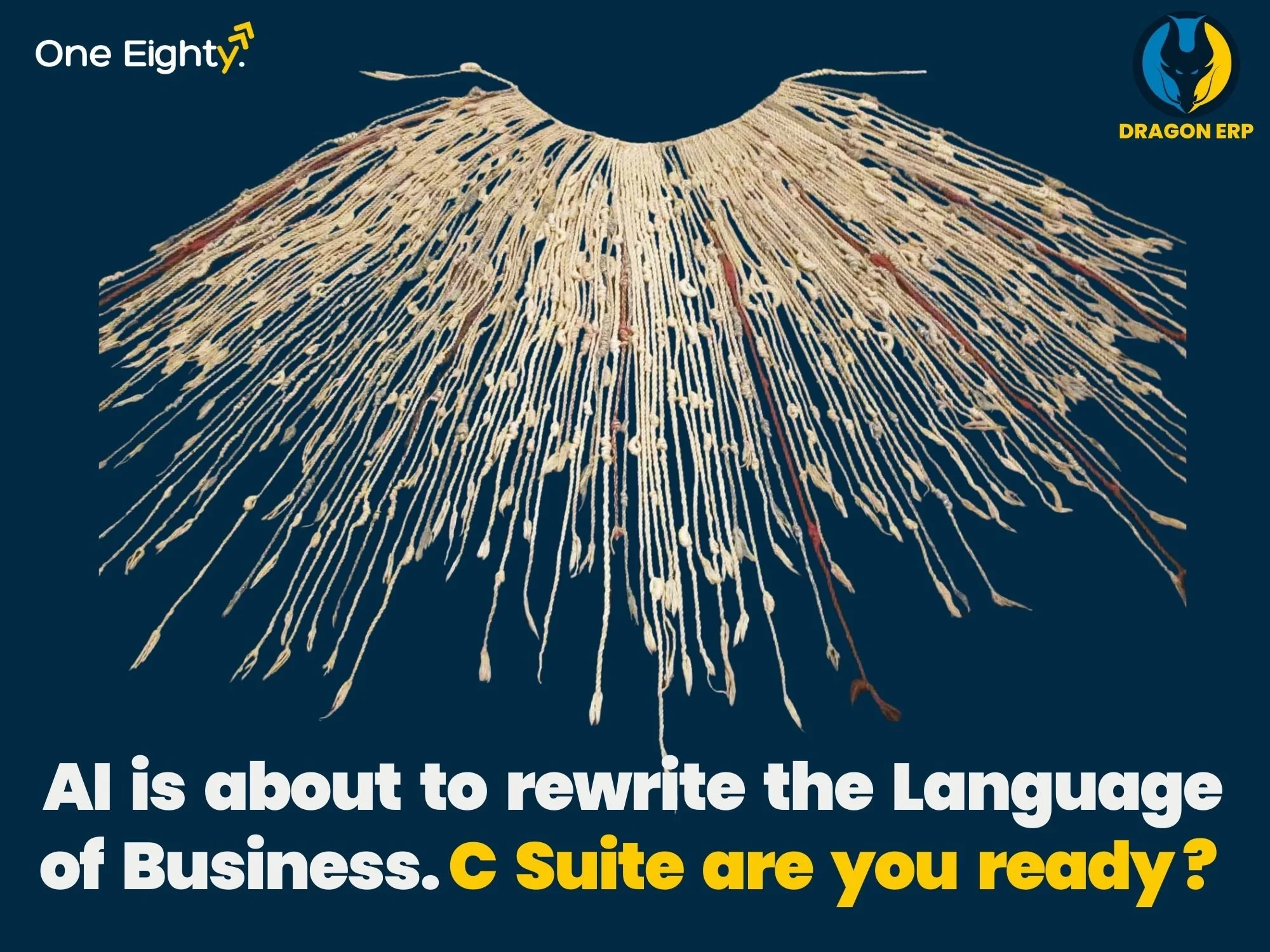
How the image links to Sapir–Whorf
The image is a quipu, a binary information system used by the Inca civilisation over a thousand years ago.
The quipu was a non-verbal, binary language, and a powerful illustration of Sapir–Whorf beyond spoken words. Meaning was encoded through discrete states, knot or no knot, type, position, twist, colour. Nothing was written, yet significance emerged from patterns.
In Sapir–Whorf terms, the quipu did not simply store information. It shaped what the Inca state could see, measure, and govern. Modern AI works in a similar way. Meaning is not expressed in language, it is inferred from high-dimensional on and off states.
In both cases, representation defines cognition. What can be encoded can be thought about. What cannot, effectively does not exist.
With that in mind, we can now look at how AI is about to reshape the language of business.
Sapir–Whorf and why language shapes reality
The Sapir–Whorf hypothesis, developed by Edward Sapir and Benjamin Lee Whorf, argues that language does more than describe reality. It influences how we perceive, reason about, and act within it.
The modern interpretation does not claim language traps us. It claims language biases attention, habit, and imagination.
If something has no shared vocabulary, it is harder to discuss.
If it has no recognised structure, it is harder to act on.
If it has no grammatical place, it is harder to justify.
Language is not a prison. It is a cognitive scaffold.
The Target Operating Model as the language of business
Now apply Sapir–Whorf to the enterprise.
A standard Target Business Operating Model functions exactly like a language.
The grammar, business processes and lines of business
Order to Cash
Procure to Pay
Record to Report
Hire to Retire
These are the verbs of the organisation, the legitimate sequences of action.
The nouns, semantic data
Customer
Supplier
Product and BOM
Asset
Employee
These define what exists and what can be governed.
The syntax, rules and controls
Approvals, postings, segregation of duties, close cycles.
The pragmatics, metrics and incentives
Revenue, cost, margin, utilisation, compliance.
Together, these layers form a shared, global language of business. Organisations may have accents, but very few speak a genuinely different language.
Enterprise Sapir–Whorf is real
If language shapes thought, operating models shape organisational cognition.
In practice, this shows up very clearly.
If an activity is not modelled, it is hard to justify.
If a data object does not exist, it is hard to manage.
If a process is non-standard, it feels risky.
If something cannot be reported, it struggles to matter.
The operating model does not just enable execution. It quietly defines what the organisation can easily imagine.
This is not a flaw. It is the price of scale.
Why AI breaks the model
AI changes everything because it does not live inside the business language. It observes it.
To AI, processes are executable graphs.
Data models are semantic maps.
Controls are constraints to optimise around.
Where humans internalise the operating model as how business works, AI treats it as one representation among many.
That breaks the Sapir–Whorf effect.
Transcendence, AI beyond the operating model
Because AI learns across many organisations, trains across industries, and reasons in latent semantic space rather than flowcharts, it can recombine processes in non-canonical ways.
It can invent new semantic groupings that outperform standard master data.
It can optimise end-to-end outcomes without respecting functional boundaries.
In linguistic terms, humans think through the business language. AI thinks about the business language.
That means AI can transcend the Target Operating Model, not because it is smarter, but because it is less constrained.
The inversion leaders are not prepared for
Sapir–Whorf warned that humans may be constrained by the language they speak.
The enterprise inversion is sharper. Enterprises, like humans, are constrained by their operating models.
AI is not.
AI will increasingly produce insights and actions that feel non-standard, uncomfortable, and difficult to govern. Not because they are wrong, but because they do not fit the language we are used to thinking in.
This is the dynamic explored in The AI Ghost in the SAP Cockpit.
Why this matters now
This is not an academic concern.
It matters because AI may identify value outside your operating model, and your organisation may be structurally unable to act on it. Controls designed for human-paced execution fail at machine speed. Many transformations fail not technically, but because the operating language no longer matches reality.
Firms that evolve their business language will outpace those that freeze it.
And users may no longer understand how the enterprise actually operates as processes, semantic data, controls, and analytics are reshaped to reflect AI’s view of the organisation. That loss of understanding becomes a loss of trust.
Most leaders think the risk is that AI will automate their processes.
The real risk is that AI will outgrow the language your business thinks in, and you will not notice until it already has.
A call to arms for C suite business leaders
The Business Target Operating Model can no longer be treated as finished.
Leaders now need to ask who owns the evolution of the business language ?
How quickly semantic and process layers can adapt ?
How transformation will delivered and embedded ?
Whether governance focuses on execution, or on meaning. Whether operating models are designed for humans to follow, or for intelligent agents to inhabit ?
If these questions are not answered deliberately, the answers will emerge accidentally, through AI behaviour that is hard to explain and harder to control ?
The transformation battle has moved upstream
The Target Operating Model was once a tool for efficiency. It has become the enterprise’s cognitive infrastructure.
Sapir and Whorf showed us that language shapes reality. SAP Enterprise software encoded that insight into process and data. AI is now revealing the limits of that encoding.
The future will not belong to organisations with the cleanest operating models.
It will belong to those that continuously redesign the language their business thinks in.
Because in the age of AI, strategy is no longer just about decisions. It is about which realities your organisation is capable of imagining at all.
Dragon ERP is here to help
AI strategy is not a technology decision. It is a language decision.
If your organisation is standardised but strategically constrained, investing in AI but struggling to operationalise insight, running transformations that are technically sound but directionally stuck, or unsure whether your operating model enables or limits intelligent automation, then the issue is not tech tooling.
It is the language your enterprise thinks in.
This is exactly where Alisdair Bach and Dragon ERP focus their work.
Dragon ERP helps boards, CIOs, CFOs, and transformation leaders diagnose when operating models have become cognitive constraints, stabilise and turn around SAP and enterprise programmes that have lost strategic coherence, redesign process and semantic layers to be AI-ready, human-governable, and future-proof, and translate AI ambition into operating models that can actually absorb it.
This is not about chasing AI trends.
It is about ensuring your organisation can think, decide, and act at the pace AI now makes possible.
If you want an AI strategy that works with your operating model rather than breaking against it, now is the moment to step upstream.
Speak to Alisdair and Dragon ERP.
Because the organisations that win in the age of AI will not just deploy better systems. They will design better languages for their business to think in.
About the Author
Alisdair Bach is a recognised SAP Programme Director and turnaround specialist — often called a “turnaround king” by clients for his ability to stabilise and recover the most complex and failing SAP programmes. With decades of experience across global private equity and public sector portfolios, Alisdair has led high-stakes SAP S/4HANA transformations, finance and supply chain turnarounds, and complex delivery rescues.
Alisdair is also a SAP analyst working to define for investors where next with SAP, he is a author and lecturer, he defined the SAP upcycling concept as the alternate narrative to rip it out and start again clean core that is counter intuitive to AI adoption and SAPs 5X growth strategy.
Through Dragon ERP, he brings board-level assurance, forensic diagnostics, and hands-on leadership to programmes that others have written off — combining empathy with no-nonsense execution to deliver results where failure once seemed inevitable.

